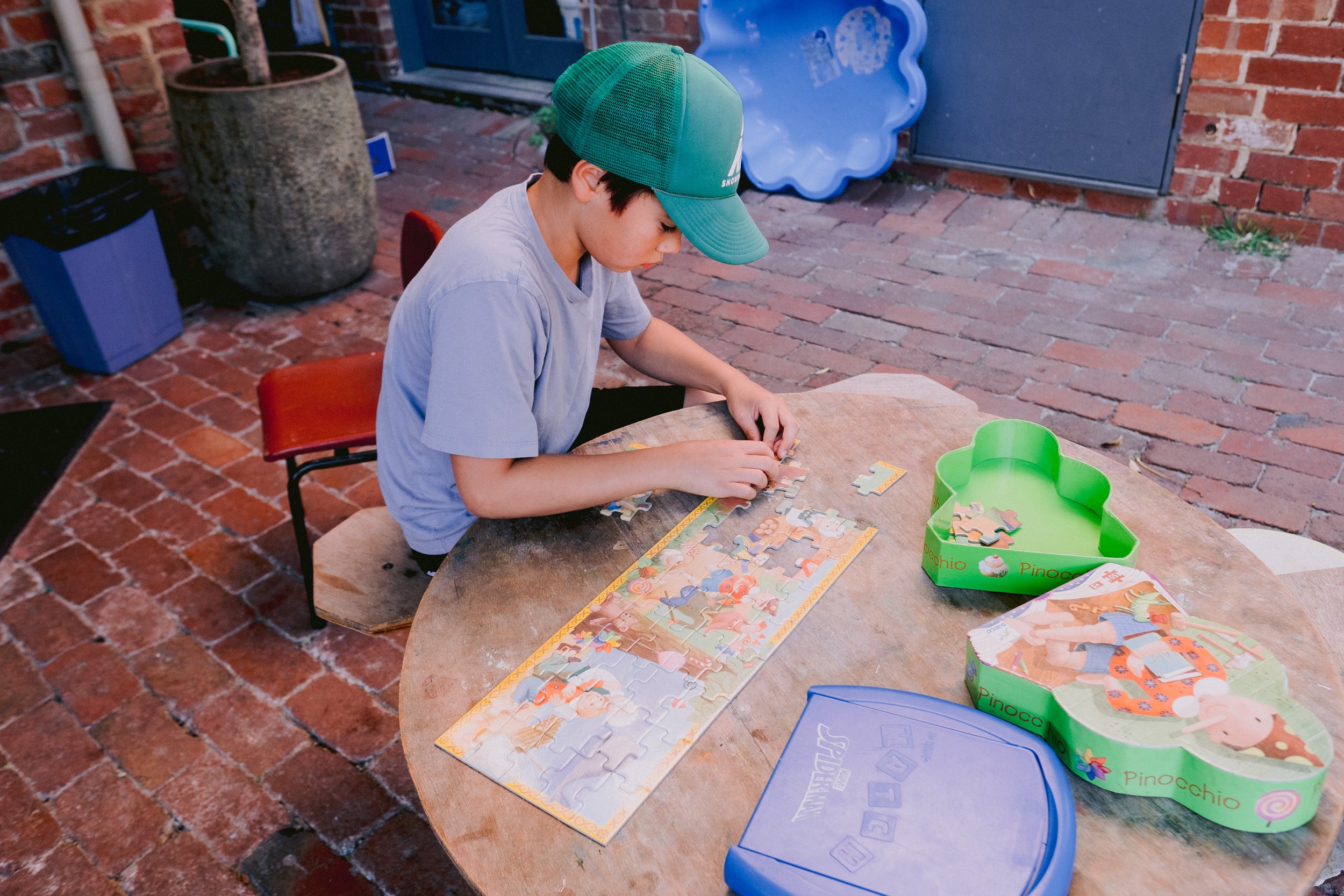
“If you wonder why we give them freetime, ask what children are like when they are not being told what to do.”
— Faye Berryman (founder)
Faye Berryman AM, Fitzroy Community School co-founder, talks about the school's philosophy.
Ethos - by Faye Berryman
FCS is not an ordinary school. While I say this without any qualification, I have to admit that I usually feel most uncomfortable when people remark, “Oh, you’re an alternative school, aren’t you?” Having had a child here for some time, most FCS parents become aware that many people outside the school population are experts on the subject of alternative schools generally - and FCS in particular - and all this, usually, without having spent a moment here!
But FCS is not an ordinary school. It is very important that we reflect on what students receive here that they would not get elsewhere. What is it that actually makes FCS different? How can we be proud to say that we are a genuine alternative to what is normally offered? For all of us, lest we forget, it's a good thing, from time to time, to reaffirm our values out loud, especially since they are not the values of the majority. This helps us keep them a reality.
What is the FCS ethos? There are two fundamental tenets:
-We take responsibility for our input into the social, emotional and ethical dimensions of child development.
-We believe that the unique, deliberately constructed lifestyle of FCS enables us to support development on this broad front.
The Lifestyle of FCS
From the moment of birth and even before, children develop by absorbing and incorporating a myriad of different influences. They are born with certain personality propensities. Then, their immediate family exerts the most significant forming influence on these innate characteristics. However, as well as the influences of the immediate family, there are many other impacting forces. We have the extended family, playgroups, crèches, kindergartens and all the various influences of the big and little people our children meet there. We have chance encounters with momentous emotional events – births and deaths, etc. And, of course, the media.
The lifestyle of FCS is a very deliberate choice. I want to draw your attention to why the particular lifestyle of FCS is so important in the development of the whole child. We spend less time than most schools in the formal classroom. Why? Why do we give camps - our sort of camps – such an emphasis? Why is free time an essential part of our day – arguably the most important part? Why do we go take the children on so many excursions? And why do we offer them the opportunity to spend significant unstructured time in nature?
Children spend many hours each day, over a period of 13 years, at school. These years, particularly the primary ones, are the most significant years in a child’s social, ethical and emotional development. Positive development in these areas most strongly determines a child’s success as a whole person. For this fundamental reason, FCS believes that the school hours each day are far too important to devote to academic proficiency alone. Academic excellence is wonderful, but this aspect of schooling is straightforward. It would be hard to equal our academic standards – but it is possible. However, in a hierarchy of values, FCS places goodness and viability first and foremost.
Link to The Wider World
At FCS, we have established a way of life that more closely reflects life in the wider world. It allows each child to be seen, and to be known by those of the community. It gives the young people opportunities to come to know themselves as they relate with a variety of others, young and old—to learn which behaviours result in positive exchanges and which lead them into unhappy situations.
If you wonder why we give them free time, ask what children are like when they are not being told what to do. What are their strengths and weaknesses? If they can discover these, they can evolve, and we can encourage personal growth. This is the true meaning of education, a far cry from mere schooling.
At FCS, therefore, it is possible to experience the child as a whole person, not the minimal creature who always has the support of a definite structure or someone's instruction. Nor is the child seen just as one who performs academic feats more or less well, with a greater or lesser degree of cooperation.
Along the pathway from childhood to adult life, all children contend with a variety of influences—some of them conflicting—at any given time. Consequently, children experiment with many ways of being. Children depend on the significant adults in their lives to give them authentic feedback on the acceptability, or otherwise, of the behaviours and attitudes they display.
The Questioning
What follows is a presentation of the ‘conversation’ that Faye and Philip had in starting the school. This is in 1976 and Faye and Philip then had three school age children and were reflecting upon what/where/how they should be schooled.
Our Initial Questions
We asked each other, “Where shall we send our children for schooling?”
We decided to approach the question rationally and asked first, “What is the purpose of schooling?”
"To enable the child to participate in the world confidently, competently, and happily,” we supposed. “By what method does schooling achieve this goal?” we wondered.
The most important skills
We mumbled the usual things like the teaching of reading, writing, arithmetic, etc., and then summarised this as the development of various skills.
We then asked ourselves, “What are the most important skills for a child to grow in?”
Reflecting on our own life experiences and on the causes of unhappiness that we could see in the world around us, it did not take us long to agree that the most pressing aspect of development for any young human was interpersonal communication skills. This was the key to long-term success in both personal life and career satisfaction.
This then was our first strong conviction on the subject of schooling.
Challenges with Traditional Schools
Assessing Available Schools
With a sense of relief that we finally knew what we were looking for, we settled back into our armchairs and asked the innocuous question “Which schools best serve this need of children?”
But our comfort was short-lived as it soon became painfully obvious, mentally scanning the selection of schools available, that the school industry largely neglected children in this most important of all areas!
Problems with Traditional Schooling
If you compare a group of school beginners with a group of school leavers you have a stark demonstration of a hidden curriculum that actually robs children of their expressive and communicative powers – and with it the all-important self-confidence.
Help! It was becoming obvious why parents generally avoid examining school life too closely. You have to give your children over to a school, but what is a parent meant to do when they discover that the school they’ve just looked at is not just failing to achieve the aspirations they hold for their child, but appears unaware that the nature of the schooling experience even matters.
We expressed our concerns to anyone who would listen and soon found ourselves joining a group of parents to form an alternative school. High hopes. A great pool of parental energy. Several eager meetings.
Internal Strife in Alternative Schools
But dark clouds again... We found that, meeting by meeting, the parent group was becoming more harshly divided. These parents were dedicated, concerned, and like us, opinionated. It is after all the right and duty of parents to raise their children according to their values and beliefs. But there were so many areas of conflict. There were as many theories as to how the school should be run as there were parents. Even spouses were divided!
The movement collapsed before our eyes. Unbeknown to us at the time, the same distressing experience was befalling earnest parents all over the country.
In 1975 in Melbourne, we joined an established alternative school. We contributed our goodwill, our time, our fees and our children. But alas, the same problem of in-fighting was eating up this school too.
Realising the Committee System's Flaws
We investigated and soon came to discover that “community” schools everywhere were collapsing from within. The committee system (which might be essential in some large organisations), when applied to small-scale, self-governing schools was shredding any hope of effectiveness – or even survival. All around Melbourne, these new alternative schools were falling like flies.
A New Type Of School
November 1976 - A Bold New Idea
We were on the verge of giving up all hope of finding a school that truly served the child, when a bold thought entered our heads. We could START OUR OWN SCHOOL.
Faye had been a secondary teacher and a social worker. Philip had been a university philosophy lecturer and had written on education. We knew what we wanted in a school. In a nutshell, our vision for school was a place that in which the children enjoyed a happy lifestyle, and which encouraged interpersonal communication skills and grew self-confidence.
Establishing the School
We felt that we could bring this about through creating, from day one, the culture and structures we felt best supported children to grow. To this end, we reflected that a small school gave us the greatest ability to form the culture we wanted, and if we added small class sizes, the relationships would be strong and real – not institutional or distant.
We also came to the view that the children would benefit if the school was welcoming to school families. Parental presence at school would indicate to the children that their parents affirmed the school as a good place to be. Also, the children’s engagement with a wider circle of adults would mean exposure to a wider circle of ideas and approaches, which would bring gains to their effective immersion in the world outside of school.
Our thoughts, having been clarified on the type of school we intended to open, now turned to the bureaucratic hurdles we now faced. The question became:
How could we break through the obstructive and exhausting tangle of red tape associated with the founding of a new school?
We could not. But we judged that our obligation to children was greater than our obligation to bureaucracy.
So without even rising from the kitchen table, we declared the school open. There were 12 children in attendance the following morning. Four years later our little school was officially registered.
Avoiding Common Pitfalls
But wait. How shall we avoid the internal strife that has befallen the other community schools? Here, we had to seriously depart from the common practices of the day and say, “Not run by committee.”
We made the clear decision that FCS would be our school – meaning that we’d run it, and as such be responsible for its culture and practices. We’d offer our educational vision to the world, and happily engage with families who were seeking the type of childhood experiences we were offering.
The committee system on paper appears to give parents power, but all they tend to end up with is a tense, low-morale, den of intrigue. True power lies in being able to choose or reject a school. Choice is meaningless without diversity.
Our approach offered then, and continues to offer parents a school which can actually get on with the job, and lives its educational vision. It is experienced as a happy place to work, which has paid dividends for the staff and the children they educate for many decades.
Growth and Success
Within 2 weeks we had a full house of 20 children. 2 years later, we purchased the adjoining house and accepted 40 pupils. In 1994, we sold our home to the school, thereby opening up all rooms, and bought the house next door. We’ve educated 55-65 students at our Brunswick Street site for decades, and now offer our very special primary school experience to a similar number at our Normanby Avenue campus. We are lucky to have never advertised.
Our broad aspiration is that many more educators with vision will open small primary schools, allowing parents everywhere the opportunity to choose a school that aligns with their view of schooling.
— Faye Berryman (founder)
The Learning Iceberg
In our civilisation, compulsory schooling - for better or for worse - dominates the timetable of childhood.
From the tender age of around 5, right through to young adulthood, most of the day for most of the year is taken up with schooling. If you include kindergarten and childcare, you can start the count at age 4, 3, 2, or even 1.
Whatever children need during all this time away from home is what FCS aims to provide. Schools today, by default, for most children, replace both the village community and the extended family.
Officially, a school exists to teach children the necessary skills to be employable - reading, writing, arithmetic, etc. This is the curriculum.
But the official curriculum is only the tip of the learning iceberg. Because of the molding power of this second home, the child will inevitably acquire other learning too – attitudes, behaviours, and a particular view of the world.
The attitudes and behaviours we acquire and demonstrate are influenced by the daily lifestyle and interpersonal culture that prevails within the school. Ivan Illich in his classic text Deschooling Society called this the Hidden Curriculum. Despite its significant influence, the Hidden Curriculum is rarely discussed.
Adult & Child Connection
The tone of the transactions between adults (staff and parents at school) and children is set by the educator-in-charge. The quality of the leadership can make or break a school.
The behaviour and attitudes of the students are also influenced by the design of the school – the physical arrangements and the timetable.
As far as personal input is concerned, adult example is the most potent factor in socialisation. If our behaviour does not agree with our teachings, it’s the behaviour that will be copied.
Children mimic adults in ruthless detail. The underlying biological principle is that if we “oldies” have survived this long with a given modus operandi, then it must work and should be emulated.
That is why adult-adult relations within the school must be positive and affirming. It is also why the educator hires staff who genuinely value their subjects - whether music, maths, or literature. The children will take notice of whether we treasure a subject far more than the content of the particular textbooks we use.
We experienced elders know that positive human relations is the single most important ingredient in a successful and happy home and professional life. As educators, we are also acutely aware that positive human relations cannot be simply taught or explained to children – even if you say it a thousand times – but must be a lived example.
Integrity of Means and Ends
It is by actually living a code of conduct that you successfully impart it. When a school activity is failing to achieve its purpose, FCS teachers suspend the activity and discuss what’s happening and why. When everybody is again focused on the purpose, we resume the activity.
We do not forge ahead, heedless of the outcome - simply because the timetable says “Science”. Entering into the spirit of the activity is always implicitly on the timetable, and takes priority – even if you can’t see the word “spirit” actually written in every slot of the timetable.
This daily way of life, of having the mind in tune with the body, intentions in tune with actions, personal behaviour in tune with the group purpose, has certain easily discernible effects.
The most important effect ultimately is that it produces effective people - or, in the vernacular, “together people”.
Love of Learning
More immediate effects are seen in the academic outcomes and the teaching methods.
Despite spending significantly less time in class on literacy and numeracy, we consistently achieve nation leading outcomes. In addition to these NAPLAN demonstrated achievements, our success includes inculcating a love of learning and habits of study which carry through to higher levels of learning and later life.
These academic spin-offs occur simply because the time we spend in class is fruitful. When the teacher goes to the trouble of centering the students for each lesson, having them enter into the spirit of the activity, far more is achieved.
So what may prima facie appear to some as a waste of time, winning hearts and minds to the pursuit of knowledge and skill, turns out to be far more efficient, even at the level of objective assessment.
This is why we consistently say to parents of Tinies (beginners) that we do not undertake to wade through a promised amount of curriculum in the first year, because we are devoting whatever effort and time it takes to get them to engage positively in the purposes and protocols of school life.
Treasures Passed On
The other notable effect of engaging in the spirit of learning is that we do not find it necessary to disguise, decorate, or in any way apologise for the subjects we teach. Our English and Maths for example are presented directly as skills enjoyable in their own right.
Nor do we expect young children to make judgments about the true worth of whatever material we may try to teach them. This is our job as their elders - those who have gone before. They have not lived long enough to make such judgments.
Children have a biological instinct to value what we value. If we present Maths and English as treasures, they receive them as treasures, and will happily acquire the skills without sugar coating.
Contrary to the prevailing practice of trying to teach incidentally by a thematic approach (let’s do kangaroos today), we focus directly on the respective skills - such as reading, handwriting, creative writing, spelling, speech, and grammar.
We their teachers must believe in the value of what we teach – they will then receive it with open arms. That is why the Educator responsible (the principal of FCS) will always seek to employ teachers who treasure their subject. This quality we have found is worth far more than the mere holding a state-recognised document of teacher qualification.
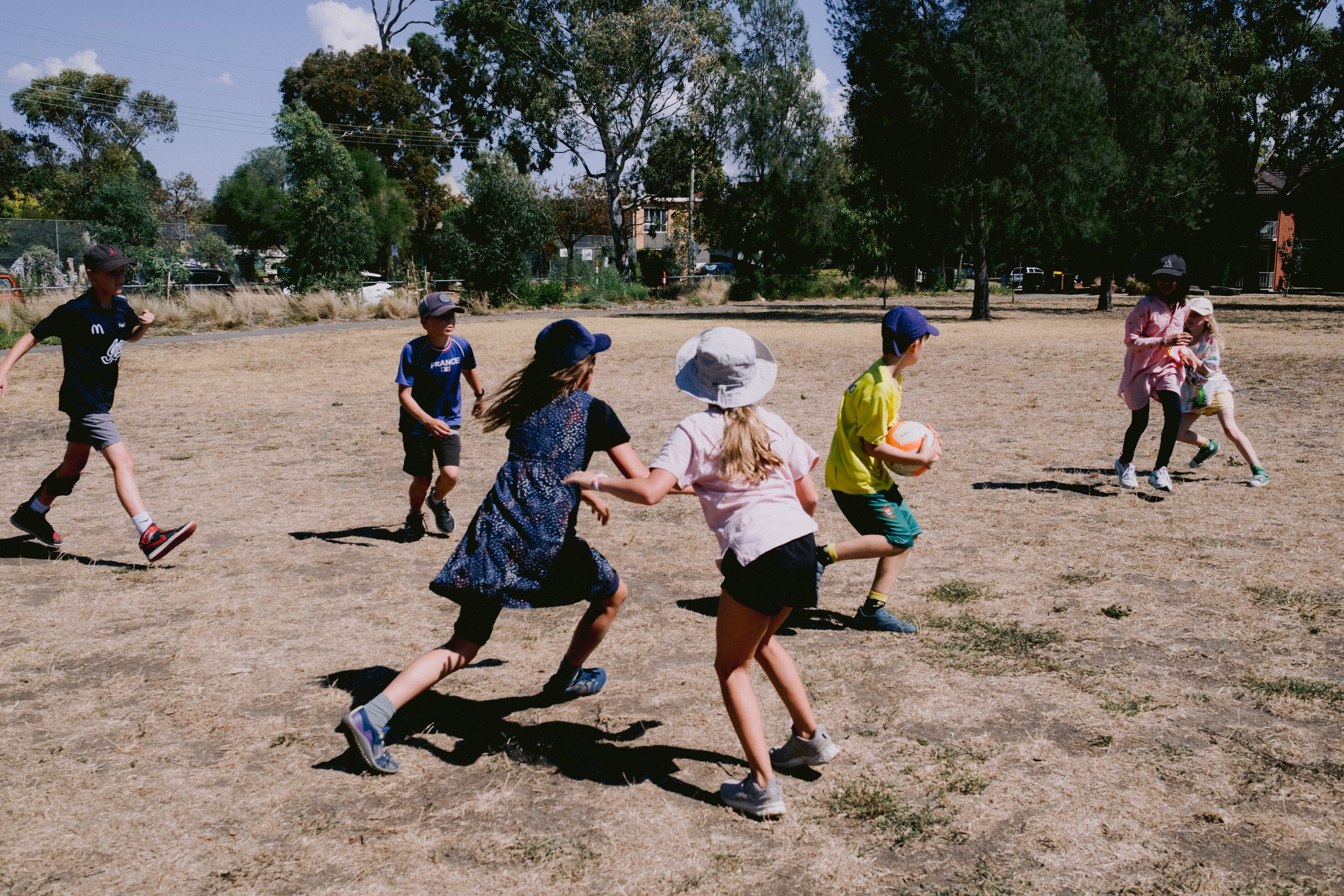
Freetime is a regular feature on the timetable. Freetime is the time when our children decide for themselves what they want to do and how they will do it. The first part of this, deciding for themselves what they’d like to do is only a real choice when they are not restricted to selecting from a predetermined list. Choosing from a list of electives is qualitatively different to choosing unrestrictedly.
In this, no claim is being made that that the scheduling of activities should be avoided. And neither is it being asserted that there are no activities that will be of benefit to children. The point is that freetime is different. In freetime the child chooses for themselves what they want to do, without prompt or restriction. In this, doing 'nothing' is as valuable as anything else if it is the child's choice.
FCS sees significant benefit in the child discovering what they like – what they want to do. This is a personal journey in which the child learns what appeals to and engages them. This is an important discovery as it underpins not just our motivations, but also whether (or not) we find meaning in our activities and pursuits. It is not uncommon for the child who joins our school a few years into their primary school journey to, on their initial encounter with freetime, declare that ‘I don’t know what to do’ and when gently prompted by a teacher that they can do whatever the like, to state that ‘I don’t know what I like’. This is a disempowered, worrisome person, as a person who has not discovered this for themselves would appear to be a candidate for manipulation.
Freetime provides a space where the child is able to discover, explore and evaluate what they like and dislike. FCS is aware that a failure to identify what is personally meaningful contributes to a future in which employment / projects may feel hollow.
Academic and technical excellence are likely to fade into irrelevance if we are unaware as to the reasons why we have pursued them. Degrees and jobs will fail to provide fulfillment if we don’t gain meaningful enjoyment in them. Unless we are in touch with what moves us, our day-to-day evolves into a progression of other-determined tasks. Meaning and fulfilment are found when there is a reason or purpose behind what we do.
Freetime is an age-appropriate means by which FCS helps its students to discover their likes and motivations. In our children’s busy world crammed full of activities: ballet, basketball, swimming, drawing, writing, yoga, violin, pottery, French, etc, and the prevalence of screens, freetime provides a small gap to dream and discover.
Freetime also provides an opportunity for children to learn how to play appropriately with each other. Appropriate here meaning in a manner that leads to a positive experience for all, a good measure of which is whether other children wish to play with them again. Simply, is the child playing in a way that other children?
That is, when a child plays, the manner of their play determines whether they are someone other children want to play with. Freetime allows a child an opportunity to discover, reflect upon and revise which actions and demeanour are attractive to others. Conversely, certain actions and mannerisms will come across as less appealing to others, and so generate resistance and pushback. The negative response similarly creates an opportunity for the child to re-assess and vanquish their less appealing traits.
FCS’s commitment to raising socially engaged, happy children is moreover buttressed through the opportunities freetime allows the teachers to observe and provide feedback to the children. specifically on how their style of play is experienced by. That is, freetime affords an opportunity to observe a child’s manner or style of play, and to flag those aspects that are un-appealing and off-putting. Conversely, there is also an opportunity to highlight approaches that enhance their appeal to others. Freetime, unlike lunchtime typically involves 10 or so children, and so allows an intimate opportunity to gain a real insight into the way in which children play.
Non-structured, suggestion free space similarly allows for caring interactions and creative exploits to bloom, while similarly providing room in which the art of negotiation and the skill of compromise may be practiced. Kindness and care flourish during freetime, especially when it involves a mixed-age group. These times typically see the older children happily involved in games and looking after the younger ones. In a similar vein, helpfulness finds an opportunity to be exhibited during freetime.
A well-managed classroom provides scant opportunities for children to reflect upon the manner in which their behavior is received by others, due to the responsibility for the class residing with the teacher. It is during the unstructured parts of the day that an opportunity to explore who one is and how one is perceived by exists. Freetime as such plays a pivotal role in self-discover and the emergence and sustenance of a happy and inclusive school culture.
What Happens On Camp
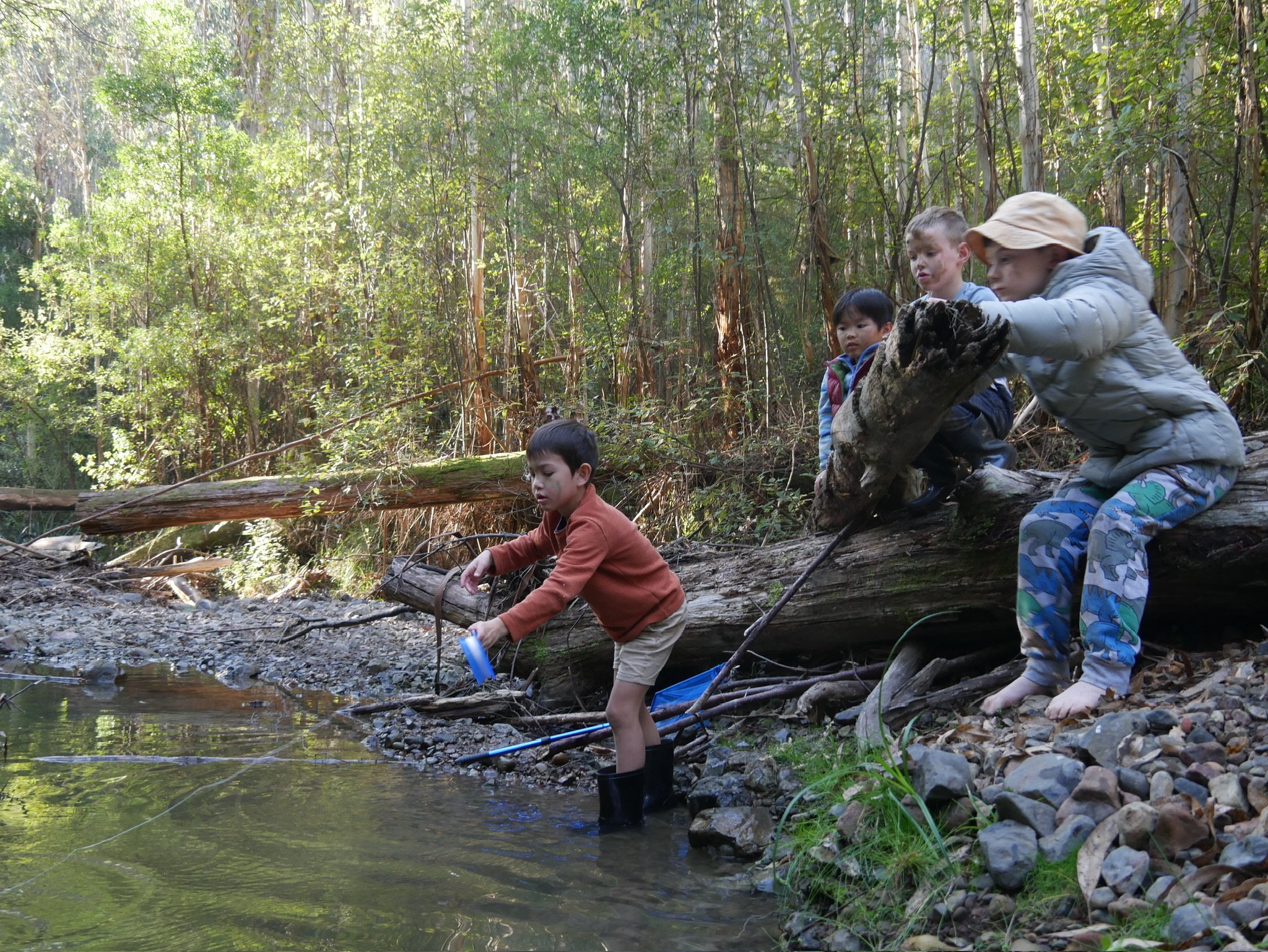
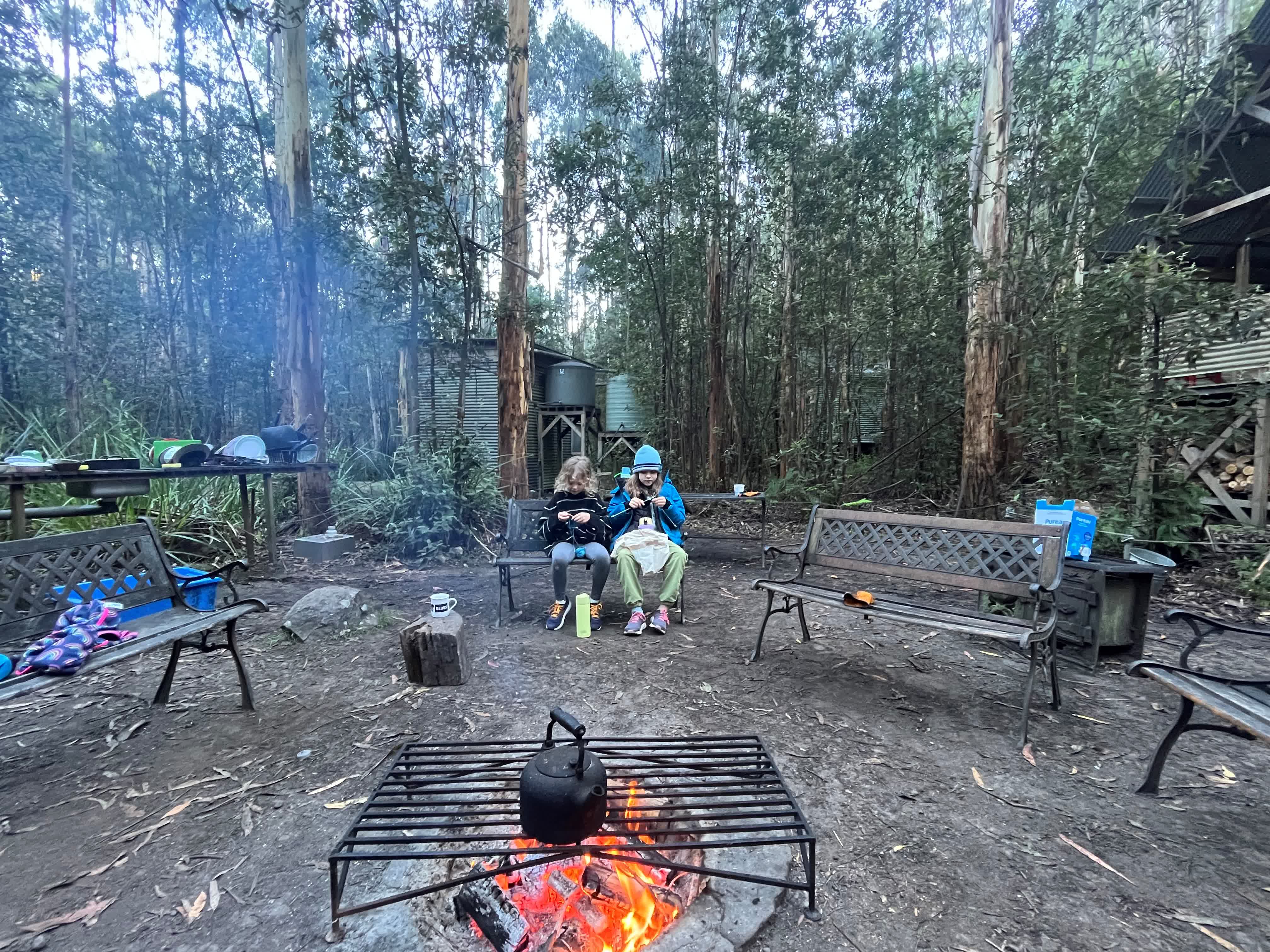
I am often asked by parents what I do, and what the children do, on camp. My part is really easy, I cook, and clean, and if it is wet, I’ll dry a pile of clothes. My day revolves around making pasta, cooking soup, stuffing jaffles, grilling sausages and making lots of cups of tea. Slicing fruit and organising a sandwich are typically spread throughout a day on camp. As I sit by the fire and prepare these snacks, or just sit in quiet contemplation in the bush, I’ll be constantly and happily interrupted by a stream of tales of wonder: of water bugs, walks, games, cubby construction, face painting, swings and the million wonders of the bush. Over the course of the camp, there will usually be one or two organised activities per day: a walk, a session of wood collecting or an exploration of an aspect of the bush of interest to the children. These will total 45-90 minutes of the day, leaving the majority of the time free for the children to explore, dream and connect. Nighttime activities include a game of spotto, a quiz or a story.
So, what do the children do? They learn… in the true sense of learn. They discover themselves, what they like, what they want to do. This is a culturally different approach to the busy, organised lives of many modern children who run from one activity to the next, and substantially different to the standard school camp experience where the children are shuffled from one activity to another. The FCS experience preferencing freetime in nature, true freetime in the sense that hints or suggestions or organised games are not offered is fairly unique. The children are simply granted time for themselves in nature.
The importance of our camps has grown as modern children are increasingly scheduled, in that it allows the children get a short period where they can drift, daydream and explore… alone or with friends. There is a value judgement here, that it is good for children daydream and drift and stop and discover things for themselves and about themselves: what they like and what they enjoy. This journey of discovery is frustrated and delayed through overly busy schedules.
Exploratory Learning
Freedom of this kind is empowering. In the absence of adult monitoring and guidance, and the lack of structured activities or entertainment, the children learn how to effectively relate to each other. Child-to-child connection is held back when adults are actively present, organising or just keeping a close eye on what the children are upto. Jonathan Haidt in The Anxious Generation recently came to the same finding. In moving briefly to the classroom experience, while it is often the most efficient and effective way to transmit a specific academic skill, the same does not apply to emotional or personal growth. An adult actively overseeing, supervising or organising annuls the possibility of the children working things out for themselves and grow these acts of agency.
When adults quietly move into the background, the children find ways to deal with life as it unfolds. Most adults in the vicinity of games on a swing, for instance, seem unable (even while I write this, I realise that this is something that I am not always so good on) to be present without getting a queue organised, 'insisting' either explicitly or implicitly, that the children have 'equal' and 'fair' turns. While the children may accept the idea of the adult as fair and use it without argument, where they may otherwise have spent considerable time discussing the arrangement – I’m not convinced that efficiency is the goal. The discussion and negotiation are real and valuable skills, skills that they can and will take with them in life and use in many settings outside of the playground. Clothing, eating, washing and dirt are similar examples, where many parents find it difficult to let go...
Close supervision is antagonistic to what I believe camps are about. The object, for me, is that the children learn/discover that they can, successfully and happily, organise themselves. That they can sort out turns on the swing and the trampoline or that they are able to take care of their eating: make a sandwich or a jaffle, eat a piece of fruit. And that getting muddy, wet or going without shoes is really a non-issue. And that even if a night to two away is initially a bit scary, it is something that they can cope with. Our ongoing experience is that conquering this slightly challenging activity boosts their confidence and so makes future challenges less scary.
In this natural setting, with the teachers quietly in the background, the child owns their interactions and achievements. The child is the master of all their accomplishments and so empowered by them. This is the clear benefit of camp structured in this way. The freedom they are given corresponds to the growth they experience. The children return to the city at the end of camp proud of their achievement: they walk taller, if dirtier, and are empowered by the encounter with their own inner strength. Sadly, in our society the inner strength of children is often hidden from them in our desire to do things for them.
In this, I do have a part, and that is to affirm the children's achievements, and to let them know that I am there for them, supportive of them. This does not necessarily take patience, but it does take time. As I said before, they (especially the younger ones) constantly present me with their discoveries, achievements, creations, stories. These are not an annoyance, or an interruption, or the cause of any frustration since I consider this my role. The elaborate story of the capture of a water-bug may take many minutes, which could be frustrating if I had work to do or an activity to organise. In seeing the exploration of the children as a primary mission of camp, I am generally free to share their discoveries, joys and excitement. My role is to affirm them as adventurers if they wish to share their adventures with me. I am there for them in the background, interested in their achievements, but neither guiding nor prompting their activities. My primary role is to affirm their strength, independence and tacitly acknowledge their ability to organise themselves.
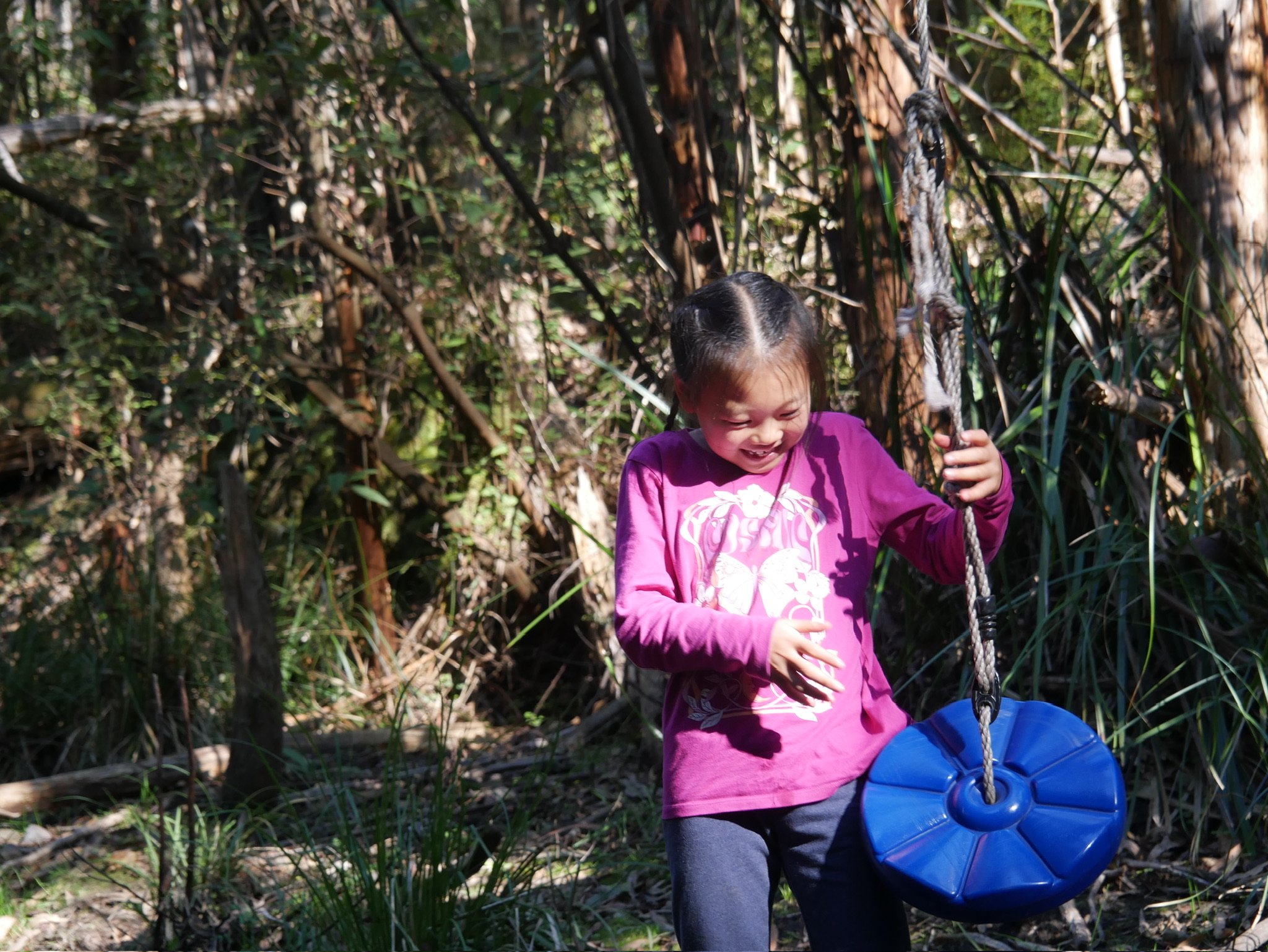
It is never our aim at FCS to make all children the same, to transform each individual into some idealised norm. Many eccentrics have made great contributions and they all started out as children!
Children are different in many ways: some are more cerebral while others are highly tactile. Some children are artistic, some empathic, while others are natural listeners. Certain children are highly active while others are quiet and shy, to name just a small subset of the many traits demonstrated by a group of children. At FCS we see all types as having a place and role to play in society – we need them all.
This approach of FCS, unique in the 1970s with its more rigid educational settings, is now relatively mainstream. The modern approach appears at times to forget that connected children are happy children. This can, in certain situations, lead to a failure by parents and teachers to give appropriate feedback to our eccentrics – that is, it can manifest in a failure to address traits and mannerisms that we adults know will push others away. At FCS, we don’t wish eccentricity to be a pathway to a sad, lonely sad future.
We love our eccentrics, but don’t see eccentricity as a reason to not engage in raising children who others will want to be around.
There are some attitudes and behaviours which are necessary for any individual to thrive in any human society. The essential social or co-existence skills come very naturally to some children, and have to be laboriously learnt by others. Parents are the primary teachers in this area – and their good work can be reinforced by teachers at school.
There are a small number of parents who think that their child is somehow exempt or can be continually excused from the universal duty to respect one’s fellow humans. In this situation there is clear difference of opinion between the school and the family. It is our ongoing experience that in this situation the family’s position will prevail as the child looks to their parents for guidance first and foremost.
Our concern here stems from our understanding that parents cannot keep their children forever. Children, irrespective of how they are viewed by their parents, will at some point need to learn to respect others or they will suffer a diminished quality of life.
This situation very occasionally leads to the saddest interactions we have with parents, where they share that while they love their children, they don’t actually like them. These parents disclose that they don’t enjoy their children’s company due to the way that their child treats those around them.
Our mission is to work with parents to raise children who others want to be around. To this end, we are willing to directly share our observations regarding the way that children push others away.
No-one is saying that social learning is equally easy for every child. However, there are minimum behavioural requirements which apply to everybody within any society. Some children have to learn the social contract more consciously and deliberately than others – with clear, consistent and compatible parent and teacher input. Children who are genuinely incapable of learning the social mores are rare, and face a future in which they will have difficulties in their interactions with others in the community. We try to assist all children as best we can in social learning.
If we at FCS see a child falling behind in age-appropriate social skills, and if our efforts to impart them are unsuccessful, our next step is to organise a chat with parents to see if we can achieve a co-ordinated approach. In the extreme case, if the parents cannot see eye-to-eye with us on the need for learning respect for one’s fellows, we know we are not benefiting the child, and we may ask them to look for a solution elsewhere.
The Dilemma
Children rely on their elders for guidance as to how to survive in the particular society they have entered. Generally, children will co-operate with adults who seriously and clearly communicate what behaviour is required.
But some parents find that they have ended up with a rebel - usually a boy. This is often a dilemma for modern parents. Should I discipline my child? When? How? What for? What, if any, behaviours should be strictly disallowed?
Questions like this are troubling for many parents at this point in our history. Parents of previous generations would dispense discipline without anywhere near as much agonising and self-doubt. No doubt, some too freely or forcefully. But have parents gone too far the other way when they let the little people run riot all over the social space?
Why the change? Well, for one thing, families are much smaller, and there is less opportunity for parents to learn from experience how to handle socialisation. And as a result there is also less cross-family example.
Secondly, as part of the rise of popular psychology, there has been a lot of theorising about "enlightened" child-raising practices. But what is a passing fad, and what is true progress?
Well, let's just talk about the two outer limits on children's behaviour - the parental and the societal. Yes, parents who lose their temper and strike out at children without self-control are, if this is ongoing, likely to traumatise their children. (Adults should never wield objects when reacting to children). Regular losing of temper is bad child-raising. Even when a parent is being strict, they should still show respect for the child as a person.
If a parent is getting stressed by a child's annoying behaviour, the parent must do something about it before they reach the point where their pent-up frustration explodes in a manner that shocks both parent and child - or worse, decays slowly into dislike.
So one outer limit is what the parent can cope with. Now, isn't that interesting? That's not based directly on the child's needs at all! But it is very important - because the child needs his or her parents, needs them to be sane, to be functioning.
Yes, it is perfectly appropriate that the child modify his behaviour in accordance with the limits of others' tolerance. Can this be overdone? Yes, if a parent becomes ridiculously intolerant. How intolerant is that? If you're always saying no, you know you are going too far.
But what if I don't mind what the child does? Now if the child is already a very co-operative type, this is believable. But some parents have trained themselves not to react even when their child tramples all over social protocol and mucks up social gatherings. Allowing this to occur is not doing the child any good. If children show no respect for others, they are progressively more excluded from social life - and both they and we lose from this. By mid-secondary, not having found a way in, social exclusion may (increasingly?) lead to sadness, anxiety and loneliness.
Setting Boundaries
Every society has behaviour limitations. There are no exceptions. Even our society, which prides itself on its rights of self-expression, locks up many thousands of (usually young male) citizens who are too unrestrained in their behaviour. And in the penal system, there are no rights at all.
Little boys become grown men in only 15 or so years. Civilised behaviour does not come automatically with age, but only through acculturation, that is social feedback, 90% of which is normally parental.
Spirited boys fare much better in this regard if parents and carers give clear and distinct personal responses in respect of particular behaviours.
What about explaining things to children? Yes, this does work with most children. But there is in every generation a subset of infants who, although they understand the words perfectly, need to actually know first hand what they can and can't get away with. There is not something wrong with these children. They have a biologically-determined need to find out for themselves what the physical (not the verbal) restraints are on various behaviours.
If these limits are not presented to them by a clear system of warning-followed-by-physical-restraint-if-ignored, these children will become confused, unhappy, and socially dysfunctional.
Sheer permissiveness is poor child-raising. Parents need to enforce some limits on children’s behaviours. But what if I can't be sure exactly which behaviours should be disallowed? This is not the most important issue. Yes, what seems important today may be overlooked in thirty years time. And what is overlooked today may become taboo in thirty years time!
What does not change is that every member of society must cope with the fact of behavioural limits. The tragedy is that some children do not realise that society has some clear limits until too late in their development, a fate that can lead to an isolated, lonely, sad future. Some limits must be set and enforced if we are to raise children who can happily connect with others.
Defining The Habit
Emotional habits acquired in childhood persist into adulthood. Parents have the right, the power and the duty to raise children as functional beings.
Whingeing is a dysfunctional habit. It undermines both rapport and morale. Whingeing is off-putting to desirable potential friends and colleagues — who won’t feel obliged to put up with it (as some parents do).
What one habitually says to oneself about one’s fortune and one’s ability to deal with it, determines one’s success. The same applies between friends and colleagues.
A defeatist attitude, habitually expressed within one’s group or family, will undermine morale — and success.
Indulged whingers lose the ability to solve their own problems. And they become unable to take charge of a situation, always seeking another to fix things for them.
Contributing Factors
Parents are the major influence in rewarding or extinguishing whingeing behaviour. A few years after starting our own school, we got to observe — through inter-school sports — how even schools can influence this aspect of personality.
We noticed when playing with some schools, that at the drop of a hat — a puff of wind or a drop of rain — the staff would whinge on behalf of the students, who would learn to whinge likewise, demanding their “rights” not to have to play under these conditions.
At another school, we observed that play would continue no matter what, and that even the parents who came to watch, would persist without mentioning the fact that they were being buffeted by weather.
Attitudes and values of resilience ultimately affect overall thriving and success in life.
To oppose a state of affairs is not necessarily whingeing. To propose a reform is often rational and constructive. To whinge is to protest without offering or taking responsibility for the solution.
Steps Towards a Cure
Whingeing is an illegitimate transaction because it habitually implies that it is someone else’s fault if life is not going according to plan and also denies that there are in reality many misfortunes which are nobody’s fault. Decision-making often involves a gamble — it demands sportsmanship. It is oppressive to be teamed with a chronic whinger.
If you’ve already got a whinger (easily done), what’s the cure?
Here are 5 suggested steps:
1. Recognise that the child can and must take a definite and growing level of responsibility for his/her own spirits;
2. Decide which occasions call for child self-management, and which occasions call for parental rescue (gradually diminishing with age);
3. Indicate your confidence in your child’s ability to survive by sometimes letting them (if necessary, directing them) to take full charge of a situation affecting them;
4. Let there be some areas which are always the child’s own business. Do not negotiate. For example, don’t buy into “There isn’t anything to do!”
5. If you’re catching up, don’t suddenly drastically change the degree of emotional dependence, but move quickly and firmly towards an age appropriate level in several small steps, respectfully but unapologetically explaining each change.
It is vital, if you want to grow a positive adult, to gradually opt out of all self-inflicted miseries. Show love, but don’t undermine the child’s sense of their own mastery of their own life, by inappropriately carrying them.
It is our job to ready them to use their wings. Let’s not get tangled in their feathers.
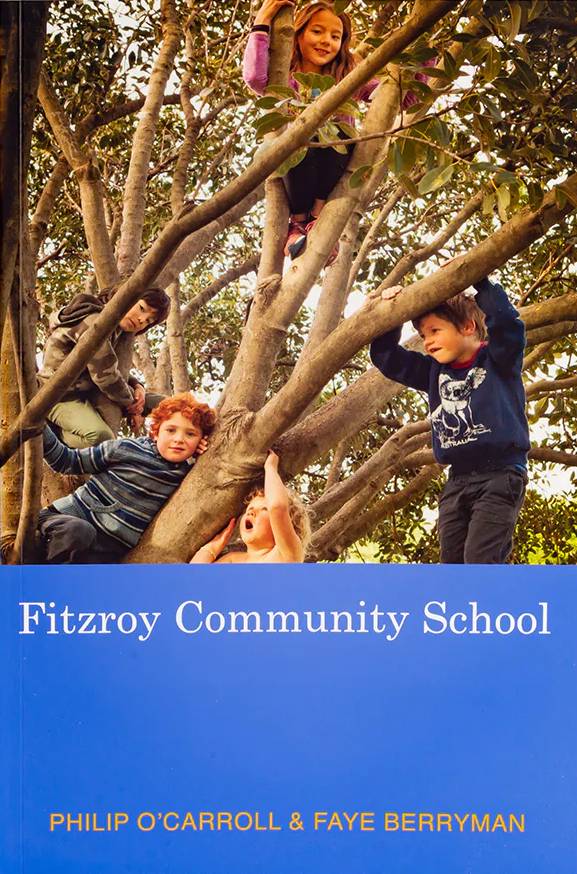
FCS - The Book is Faye and Philip's story of their journey in founding and running their school for nearly three decades, before handing their treasured gift to their son Tim. The book recounts the founding of the school, difficulties encountered, discoveries made and their vision for a better quality of childhood for all Australian children. A must read for those interested in education, schooling and childhood.
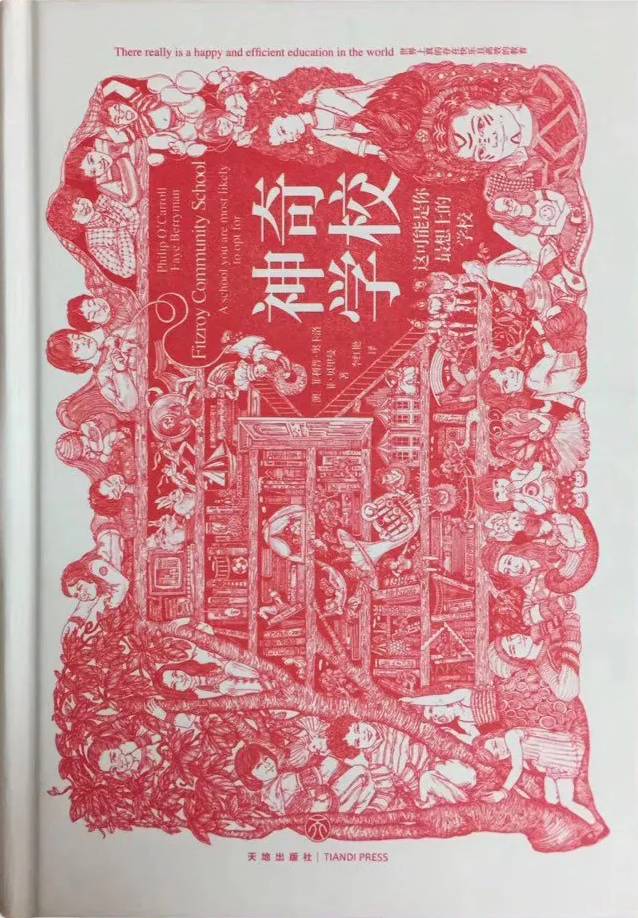
Faye and Phillip’s education journey has been translated into Chinese and inspired many parents and educators in this vast land.